

7 Digital Marketing Myths That Are Killing Your Small Business Growth
28
Aug
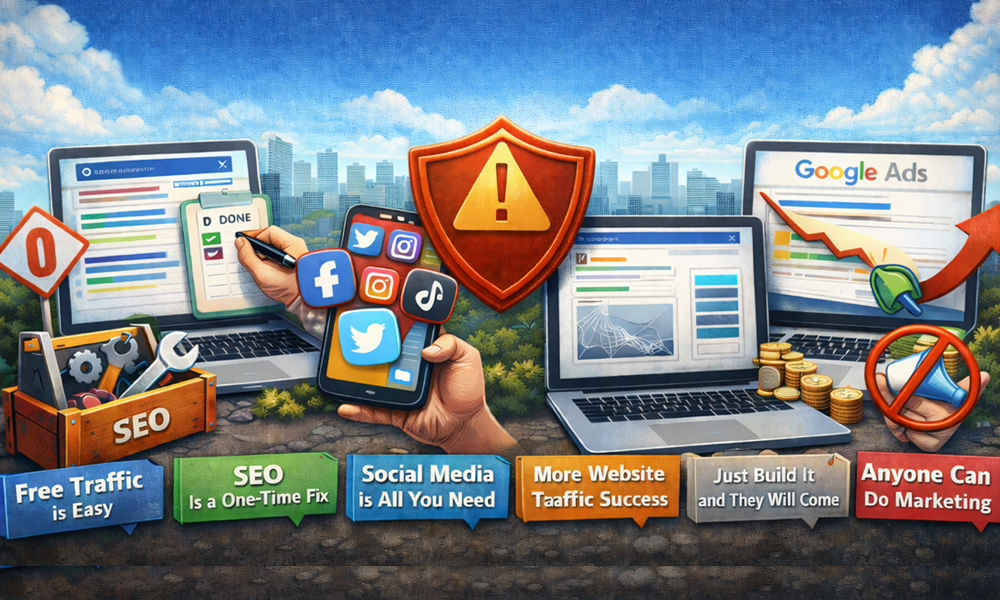
In the rapidly evolving digital landscape of 2026, small business owners are often bombarded with "expert" advice that is either outdated or flat-out wrong. Following the wrong map can lead your business into a financial dead end, wasting precious time and resources on strategies that simply don't move the needle. These myths create a barrier between you and your potential customers, often making digital marketing feel more like a burden than the growth engine it’s meant to be.
To thrive this year, you must separate fact from fiction. Many common beliefs that worked five years ago are now actively sabotaging your rankings and conversion rates. Let’s debunk the seven most dangerous myths that might be holding your small business back from its true potential.
1. Myth: "Digital Marketing is Only for Large Corporations"
Many small business owners believe that digital marketing requires a massive budget and a dedicated team of twenty people. They see big brands running high-production video ads and assume they can't compete. This mindset leads to a "do nothing" approach, which is the quickest way to stay small. In reality, digital marketing is the ultimate "great equalizer," allowing a local boutique or a specialized service provider to reach their exact target audience with surgical precision.
The beauty of marketing in 2026 is its scalability. Small businesses can start with hyper-local SEO or targeted social media ads for as little as the price of a daily coffee. By focusing on a specific niche or neighborhood, you can actually outrank larger competitors who are trying to speak to everyone at once. You don't need a million dollars; you just need a smart, focused strategy that plays to your local strengths.
2. Myth: "You Need to Be on Every Social Media Platform"
There is a common misconception that being "everywhere" is the key to success. Small business owners often burn out trying to maintain a presence on TikTok, Instagram, LinkedIn, Facebook, and X (formerly Twitter) all at once. This results in thin, generic content that fails to engage anyone. When you spread yourself too thin, your message loses its impact, and your engagement metrics suffer, telling the algorithms that your content isn't worth showing to others.
The fix is to find where your "perfect customer" hangs out and master that one platform first. If you are a B2B service provider, your time is likely better spent on LinkedIn than on TikTok. If you run a visual-heavy business like a bakery or a florist, Instagram should be your home. Focus on building one high-quality, engaged community rather than five "ghost town" accounts that offer no value.
3. Myth: "SEO is a One-Time Setup"
"I've already done my SEO when I launched the site" is a phrase that keeps many businesses stuck on Page 3 of search results. Some owners think that adding keywords to their homepage once is enough to keep them at the top forever. However, Google’s algorithm is a living, breathing entity that updates thousands of times a year. What worked in January might be penalized by June, and your competitors are constantly working to take your spot.
SEO is more like a gym membership than a surgery; you have to keep showing up to maintain results. It requires regular content updates, monitoring technical health, and adapting to new search behaviors like voice and AI search. If you treat SEO as a "one-and-done" task, your visibility will inevitably decay as more active businesses climb over you in the rankings.
4. Myth: "More Traffic Always Equals More Sales"
It’s easy to get addicted to "vanity metrics" like website hits or social media likes. Business owners often celebrate a spike in traffic, only to find that their bank account remains unchanged. If you are driving thousands of visitors to your site, but they aren't the right visitors, that traffic is essentially worthless. High traffic without conversions is like having a hundred people walk into your store just to use the air conditioning and walk back out.
The goal should always be "qualified traffic." It is better to have 100 visitors who are ready to buy than 10,000 visitors who are just browsing for free information. Effective marketing focuses on the "intent" behind the search. By targeting specific, high-intent keywords and creating clear "Call to Actions" (CTAs), you ensure that your digital marketing efforts are actually contributing to your bottom line.
5. Myth: "AI Can Handle All My Marketing Without Human Help"
With the rise of sophisticated AI tools in 2026, many small businesses have fallen into the trap of letting bots write every post and respond to every comment. While AI is a powerful assistant for data analysis and drafting, relying on it 100% makes your brand feel robotic and untrustworthy. In a world flooded with AI-generated noise, customers are craving human connection and authentic brand personalities more than ever.
AI lacks the "lived experience" and unique voice that makes your small business special. Use AI to speed up your workflow such as generating ideas or outlining articles but always ensure a human provides the final "polish." Your customers want to know the people behind the business. If they feel like they are talking to a machine, they will take their loyalty elsewhere to a brand that feels real.
6. Myth: "Email Marketing is Dead"
Every year, someone claims that email is a thing of the past, replaced by social media or messaging apps. Yet, in 2026, email remains the channel with the highest ROI for small businesses. Unlike social media platforms, where an algorithm change can hide your content from 90% of your followers overnight, you "own" your email list. It is a direct line of communication to your most interested customers that no one can take away from you.
Small businesses that ignore email are leaving money on the table. A simple, well-timed newsletter or a "welcome" automation can turn a one-time visitor into a repeat customer. People may scroll past a social post in a second, but they still check their inboxes with intention. When done correctly offering value rather than just constant sales pitches email is the strongest tool for building long-term customer relationships.
7. Myth: "I Can Do It All Myself"
The "DIY" spirit is what makes small businesses great, but it can also be their downfall when it comes to marketing. Many owners spend hours every week struggling with complex ad managers, SEO technicalities, and graphic design, taking them away from what they actually do best: running their business. Marketing is a full-time profession that requires staying updated on daily shifts in technology and consumer behavior.
Trying to do it all usually results in "good enough" marketing that yields mediocre results. Sometimes, the most profitable move a small business can make is to partner with a digital marketing expert. This allows you to focus on operations while professionals ensure your brand is being seen by the right people at the right time. Investing in expertise is often cheaper than the cost of the mistakes you’ll make while trying to learn it on the fly.
Is Your Strategy Fact-Based or Myth-Driven?
Breaking these habits is the first step toward real, measurable growth. Once you clear away the myths, the path to Page 1 becomes much clearer.
Leave a Comment