

SEO vs. SEM: Which Strategy Will Grow Your Business Faster?
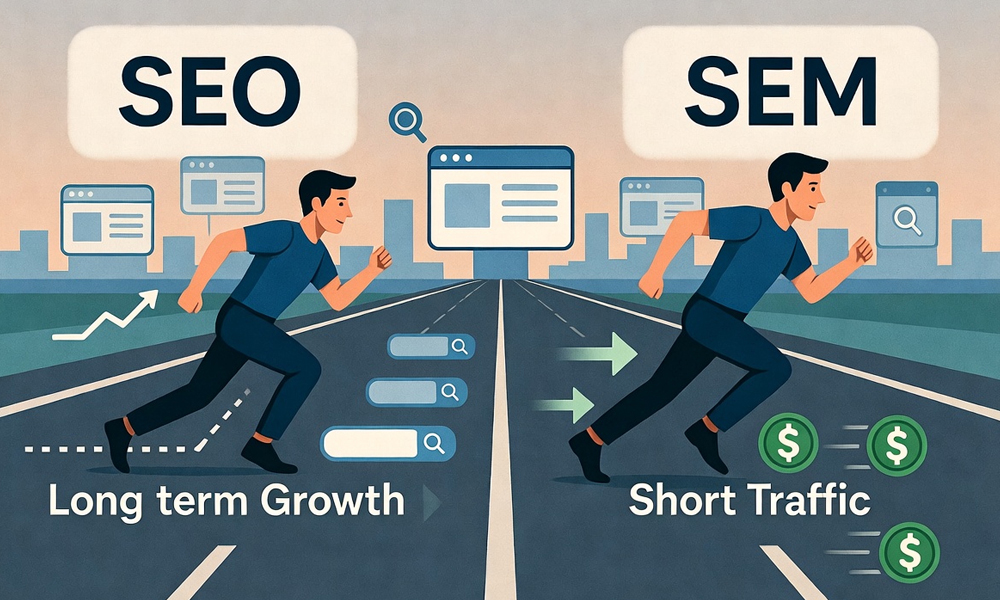
In the digital landscape of 2026, the search bar is the modern-day storefront. For any business looking to scale, the question isn’t whether you need to be on Google, but how you plan to get there. This brings us to the ultimate marketing showdown: Search Engine Optimization (SEO) versus Search Engine Marketing (SEM). One is a slow-burn strategy that builds long-term authority, while the other is a high-octane engine designed for immediate impact.
Choosing between the two or finding the right balance can determine how quickly you hit your revenue targets. If you invest too heavily in the wrong area, you risk either burning through your budget too fast or waiting too long for leads that never arrive. Let’s break down these two heavy hitters to see which path to growth is the fastest for your specific business goals.
1. Speed to Market: The Instant Win vs. The Patient Climb
When it comes to pure speed, SEM (primarily Google Ads) is the undisputed heavyweight champion. With a well-structured campaign, you can have your business appearing at the very top of search results within hours of launching. In 2026, where consumer trends shift in the blink of an eye, the ability to turn on a "tap" of targeted traffic is invaluable for seasonal sales, new product launches, or startups that need to prove their concept immediately.
SEO, by contrast, is a marathon. It involves technical audits, content creation, and building digital trust all of which take time for search engine algorithms to verify. While you won't see results overnight, the growth generated by SEO is cumulative. It’s the difference between buying a lead (SEM) and building an asset that generates leads for free (SEO). If your goal is "faster" in terms of immediate cash flow, SEM wins; if "faster" means sustainable growth that doesn't stop when your wallet closes, SEO is your play.
2. Cost Dynamics: Pay-Per-Click vs. Compounding ROI
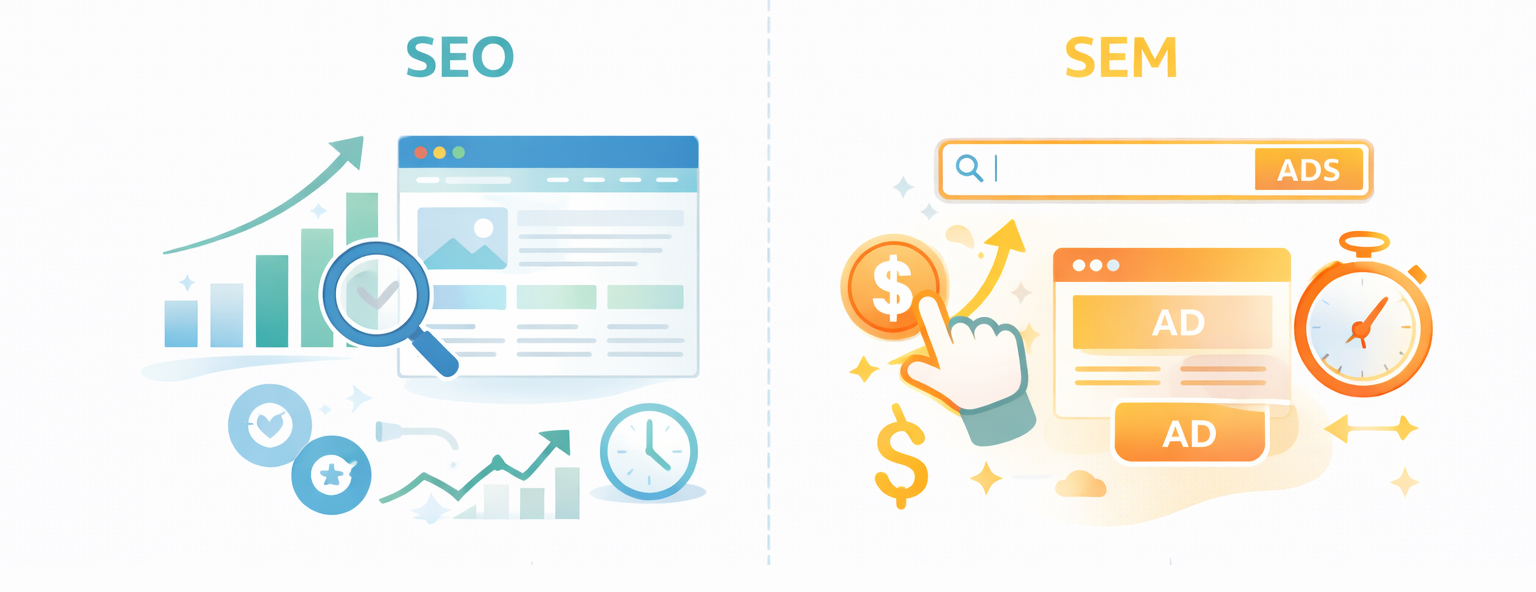
The financial structure of these two strategies couldn't be more different. SEM operates on a "pay-to-play" basis; every visitor has a price tag. While this offers incredible transparency you know exactly how much it costs to acquire a customer it can become expensive in competitive industries. As soon as you stop spending, your visibility vanishes. In 2026, high-performing SEM requires constant bidding adjustments and ad-copy refreshes to keep the Cost Per Acquisition (CPA) from spiraling.
SEO requires an upfront investment in expertise and content, but its long-term ROI is significantly higher. Once you rank for a high-value keyword, you don't pay for the clicks that follow. Over time, the "cost-per-lead" of an SEO strategy effectively drops toward zero. For a business looking to grow "faster" in terms of profitability and margin, SEO eventually outpaces SEM by providing a steady stream of "free" traffic that keeps your marketing budget lean as you scale.
3. Targeting Precision: Reaching the Right Mindset
In 2026, SEM has reached a level of surgical precision. You can target users based on their location, the time of day, the device they are using, and even their past browsing behavior. This makes SEM ideal for "high-intent" moments when someone is looking for a "plumber near me" or a "last-minute flight." You are effectively inserting your business at the exact moment of a transaction, which is the fastest way to turn a searcher into a customer.
SEO targets the "informational" mindset. It captures users when they are researching, comparing, and learning. While these users might not buy in the next five minutes, SEO allows you to build a relationship with them early in their journey. By providing the best answers to their questions, you establish your brand as the expert. When they are finally ready to pull out their credit card, yours is the only name they trust. This builds a "faster" path to brand loyalty and repeat business.
4. The Hybrid Approach: The Secret to 2026 Growth
The most successful businesses don't actually choose one over the other; they use a "Search Dominance" strategy. By running Google Ads (SEM) while simultaneously building your organic presence (SEO), you take up more "real estate" on the search results page. This double-presence builds massive credibility. Users who see your ad at the top and your organic listing right below it are far more likely to perceive you as the market leader.
Using SEM data to fuel your SEO is the fastest way to grow. You can use paid ads to test which keywords actually lead to sales, and then focus your long-term SEO efforts on those high-converting terms. This eliminates the guesswork that often makes SEO feel slow. By using SEM for immediate insights and SEO for long-term stability, you create a growth engine that is both fast to start and impossible for competitors to stop.
Which Growth Engine is Right for You?
Whether you need the "lightning strike" of SEM or the "growing forest" of SEO, the best time to start was yesterday.
Leave a Comment